
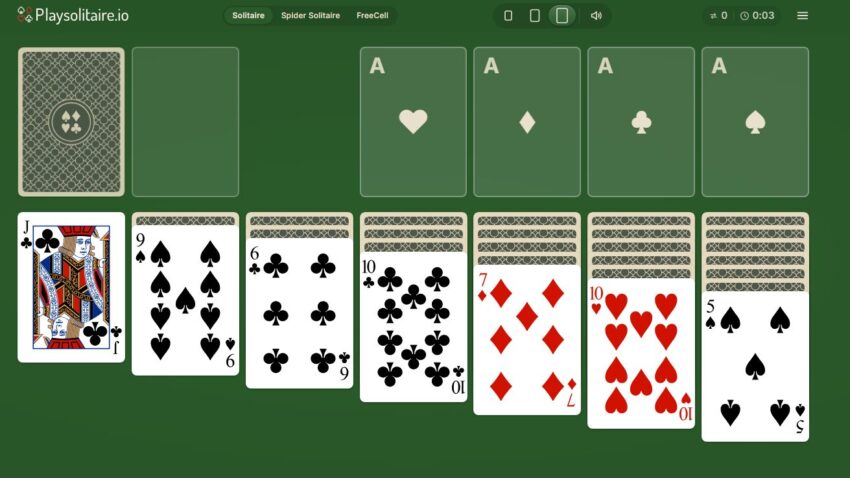
The indie scene has spent the last decade falling in love with small games – the jam entries, the one-mechanic wonders, the tiny personal projects built by a single person over a weekend. We celebrate them for their focus, their honesty, and their refusal to pad a good idea into a bloated one. But the original small game wasn’t made by an indie at all. It was a deck of cards. Decades before “scope creep” became a dirty word, solitaire – the same game you can still open in a browser at Playsolitaire.io – quietly proved that one idea, fully realized, could outlast almost everything built around it. The indie movement isn’t inventing the small-game philosophy. It’s vindicating it.
The following post is a sponsored article written by MN Media s.r.o.
What “Small Game” Actually Means
In indie circles, “small” was never an insult. It’s a design value, and a hard-won one. A small game takes a single idea and executes it completely, trusting that a clear, well-made loop matters more than a sprawling feature list. It’s the game jam mentality scaled up: constraint as a creative engine, focus as a feature rather than a limitation.
The best small games share a certain honesty. They aren’t trying to be everything, monetize your every session, or keep you on a treadmill. They have something to say or a feeling to give, they deliver it, and they let you go. That ethos – personal, focused, complete – is the beating heart of the indie movement, and it stands in deliberate opposition to the bloated, never-finished, engagement-maximizing design that dominates the mainstream.
Solitaire Was Doing This All Along
Now look at solitaire through that lens. It is a single, perfectly understood mechanic, realized completely, with nothing extraneous bolted on. There’s no progression treadmill, no second system grafted over the first, no attempt to turn a quiet card game into a sprawling platform. It is exactly as big as it needs to be and not one feature larger.
It also nails the things indies prize most. The scope is tight enough that the whole experience is legible at a glance. The loop is replayable forever because every deal is a fresh puzzle. And it respects you completely: it asks for a few minutes, gives them back, and never once tries to keep you hooked past the point you wanted to stop. If a solo developer released solitaire as a jam game today, with no history attached, we’d praise it as a masterclass in doing one thing flawlessly.
What Indies Rediscovered
The modern indie boom has, in a sense, spent years arriving at conclusions solitaire embodied from the start. The principles line up almost exactly:
- Scope isn’t quality: A focused game built around one strong idea routinely outshines a bigger one spread thin. Solitaire is one mechanic; it’s also one of the most-played games ever made.
- Constraints breed clarity: Working within tight limits forces the kind of ruthless focus that makes a game legible and satisfying, the same discipline a 52-card deck imposes by design.
- Finished is a feature: A complete, self-contained game that needs no roadmap or live updates is increasingly rare and increasingly valued. Solitaire was “done” decades ago and never needed a single patch.
- Respecting the player pays off: Games that don’t manipulate or trap their audience build genuine, lasting affection. Solitaire has earned exactly that, quietly, for over thirty years.
None of these are new ideas to anyone who’s shipped a small game. But it’s striking how completely the humble card game already answered them.
The Shared DNA
This isn’t to say indie developers are consciously copying solitaire. It’s something more interesting: they keep independently arriving at the same truths it was built on. When a developer strips an idea down to its purest form, trusts a single loop to carry the whole experience, and ships something small and complete rather than big and unfinished, they’re working in the same tradition. Solitaire just got there first, by accident, and proved the model could endure on a scale almost nothing else has matched.
You can see the lineage clearly in the kinds of games the indie scene celebrates now: tight, replayable, instantly understood experiences that value craft over content volume. Card-based indies, minimalist puzzlers, jam games built around a single clever twist – they’re all drinking from the same well. The well is just very, very old.
The Quiet Vindication
There’s something reassuring in all of this for anyone making small games. The industry’s loudest voices will always insist that bigger is better, that more systems and longer runtimes and always-online services are the path forward. The indie movement is the standing counterargument, and solitaire is its oldest and most stubborn piece of evidence. A game with no marketing budget, no sequel, and no live ops has outlasted countless blockbusters simply by being small, focused, and complete.
That’s the lesson worth holding onto. The small-game philosophy isn’t a charming limitation or a stepping stone to something bigger. It’s a legitimate, durable way to make things that matter – and it has the receipts. Indies didn’t discover that scope can be a trap and focus can be a superpower. They rediscovered it. Solitaire knew all along.
About The Author
